-
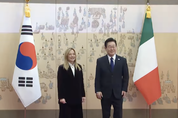
Diplomacy President Lee and Prime Minister Meloni Meet at Cheong Wa Dae to Spur Semiconductor and AI Cooperation
President Lee Jae-myung and Italian Prime Minister Giorgia Meloni held a summit at Cheong Wa Dae on January 19 and agreed to significantly strengthen their strategic partnership in advanced manufacturing and future core technology sectors. Through this meeting, the two nations established a concrete cooperation framework for their public institutions and private-sector companies with the signing of an "MOU on Semiconductor Cooperation" drawing the most attention. The agreements are interpreted as demonstrating both nations' resolve to strengthen cooperation amid the global semiconductor supply
- David Kendall 기자
- 2026-01-19 15:50
-
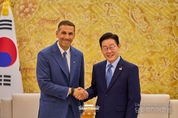
Diplomacy Korea-UAE: A Future of Trust Blooming in the Desert
On January 15, two men— President Lee Jae-myung and Khaldoon Khalifa Al Mubarak, Chairman of Abu Dhabi's Executive Affairs Authority—shook hands in the reception room of Cheong Wa Dae. Held before a wall covered with traditional symbols for longevity emblazoned in gold, their meeting reaffirmed a “century-long companionship,” one that began around 16 years earlier when a delegation led by Korea Electric Power Corporation (KEPCO) won a contract to build a nuclear power plant complex in Barakah, UAE, in 2009. Chairman Khaldoon’s smile in the photograph is genuine; he considers Korea his “second
- David Kendall 기자
- 2026-01-19 14:58
-
1

Where Tradition and Modernity Meet: The 2026 Korea Masters Invitational Exhibition Opens in Insadong
-
2

Shared Pain, Shared Promise: Azerbaijan and Korea Reflect on Khojaly at Third Annual Symposium
-
3

KGCCI and KNCW Sign MOU to Advance Women's Leadership in Korea
-
4

Singapore President Highlights Shared Values with Korea at State Dinner
-
5

AI Partners and Cultural Allies: Korea and Singapore Deepen Ties
-
6

KAF Program Helps Startups Enter Africa


-
2026-03-05 17:28
Diplomatic Journal 3 March 2026 Vol.203, TURKMENISTAN AND THE REPUBLIC OF KOREA EXPAND COOPERATION
-
2026-03-04 12:17
Presidents Lee and Marcos Mark 77 Years of Korea-Philippines Friendship at State Banquet
-
2026-03-04 11:56
Korea and Philippines Deepen Strategic Partnership at Malacañang Summit
-
2026-03-04 10:28
President Lee and PM Wong Chart New Course for Korea-Singapore Strategic Partnership
-
2026-03-04 09:47
Cheong Wa Dae Staff Ordered to Work on Public Holiday Amid Middle Easl Tensions

Address: Doosan We've Pavilion 1203, Sambong-ro 81, Jongno-gu, Seoul
Date of first registration: Founded in 1996 as UN News, changed its name to The Diplomatic Journal in 2009
Registration No.: Jongno Ra00125/ Registration Date: 2009-04-14/ Registration Number: Seoul 아54606 / Registration Date: Dec. 13, 2022
Publisher: Damwha Media Group Chairman Lee Jon-young
Editor in Chief: Lee Jon-young/ Vice Chairman: Chung Bo-won/ Standing Advisor Lee Keon-chan / Senior Editorial Writer Ko Jae-hwe / Editorial Writer Lee Se-hoon / Cultural Editor Lee Joon-seok/ Political Editor Lim Han-choong/ U.S. Branch Head Kim Joon-bae/ Business Editor Kayla Lee
Phone number: 02-3417-1010 | 02-396-5757
E-Mail: djournal3417@gmail.com

UPDATE: 2026년 03월 05일 17시 28분